
Beyond the Skimmer: A Smarter Way to Care for Your Pool
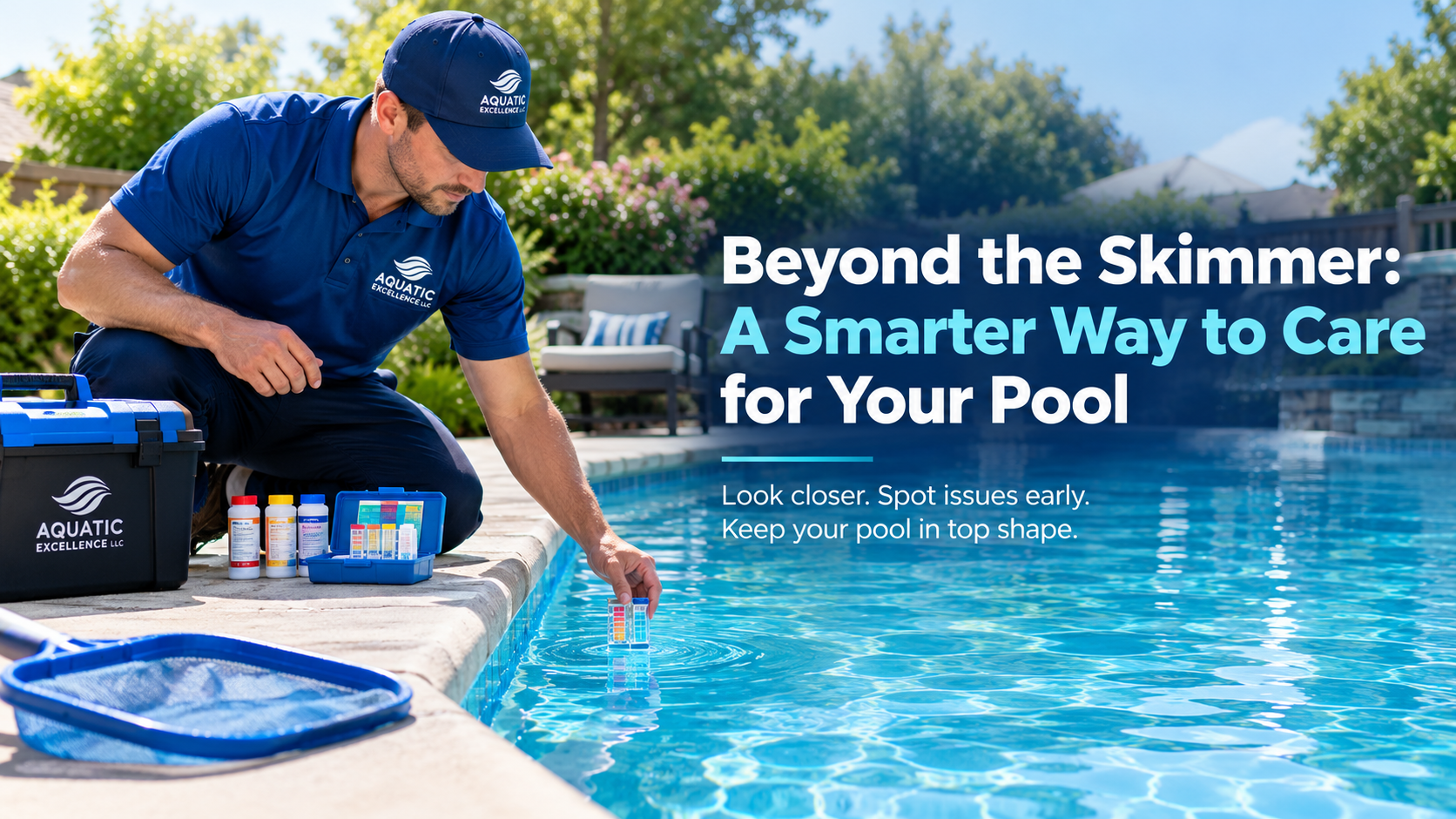
Pools maintenance history can be seen in minute details like how quickly debris returns after cleaning, water staying clear between visits and how well the circulation system works. Patterns convey information regarding the condition of a pool beyond what is apparent from the appearance. In our pool cleaning services in Atlanta, GA, we take the time to discuss the daily factors that play a role in water quality, equipment efficiency, and the work pools will require in the future.
We believe effective pool care starts with paying attention to what changes from one visit to the next. As a pool cleaning company, we look beyond the immediate task of removing leaves or vacuuming the floor. Our approach to reliable swimming pool cleaning centers on maintaining consistent conditions, recognizing developing concerns, and helping residential and commercial pool owners make informed maintenance decisions.
What Can a Pool’s Daily Patterns Tell Us?
Each pool will have its own maintenance patterns. Leaves can accumulate close to the steps, or leaves can leave a residue at the waterline. Water clarity may be lost rapidly after heavy usage of some pools, and after a storm in other pools. These differences can assist us in pinpointing areas in which maintenance should be increased.
We look at several practical indicators when assessing a pool’s condition:
- Debris patterns: Repeated buildup in one area may relate to wind direction, nearby trees, or water circulation.
- Water clarity: Persistent cloudiness can indicate filtration problems, suspended particles, or an imbalance in water chemistry.
- Surface condition: Slippery areas, visible algae, or residue may signal that cleaning and water treatment need attention.
- Equipment behavior: Changes in pump noise, water return flow, or filtration performance may justify a closer inspection.
No single sign automatically identifies the cause. We consider the surrounding conditions and other symptoms before determining the appropriate maintenance response. This helps us avoid treating recurring problems as if they were isolated cleaning tasks.
Why Is Pool Cleaning More Than Removing Visible Dirt?
Pools can be clean and require care. Easily seen floating debris is easy to see, but the chemistry, filtration, and circulation of the water needs to be investigated more thoroughly. A pool is likely to become more maintenance-intensive when these things are not cared for, even if its surfaces are acceptable.
Skimming, brushing, vacuuming, water testing, and inspection of available equipment may be part of our cleaning process. Every task is geared towards one of the four aspects of pool maintenance. Skimming will remove floating debris, brushing will loosen material attached to surfaces, and vacuuming will remove settled dirt. Water testing is used to make sure that there are no chemical changes to be made.
The filtration and circulation are also important. The filter collects particles and the circulation system conveys water through the system to be treated and filtered. If one of these processes is reduced in effectiveness, debris and water-quality issues can continue.
These tasks are grouped together since no one task can be replaced by another. Good circulation cannot be fixed with a clean floor and balanced water chemistry can’t remove leaves and surface buildup.
How Do Atlanta’s Weather Conditions Change Pool Care?
Outdoor swimming pools react to the environment. Atlanta’s changing maintenance needs during the swimming season are due to rainfall, wind, warm weather, and seasonal vegetation debris.
Following a storm, a pool could have more debris or water chemistry changes. Leaves, pollen and warm temperatures and sunlight can demand sanitizer. Swimming introduces contaminants like sweat, body oils and personal care product residues.
These conditions are taken into consideration when determining pool care requirements. This will be different if there is a pool beneath mature trees—it might need to be cleaned more often than a pool in an open space. Several people swimming in a pool every day might also require more stringent water quality surveillance.
Centers for Disease Control and Prevention (CDC) advises operators of public pools to test for chlorine and pH levels at least twice a day, or more often if the pool is heavily used. While residential pool routines vary, the guidance points out a critical principle: A pool’s water quality should be assessed, not based on what it looks like.
When Should We Look Beyond Routine Cleaning?
If the symptoms are recurring, then it’s time for a pool that needs more than its regular maintenance visit. We are attentive to persistent cloudy water, repeated algal growth, poor circulation, odd noises from the equipment and water loss.
These indicators do not necessarily mean there’s a significant repair. Cloudiness can be caused by chemical imbalance, insufficient filtration or suspended particles. Both options require a separate answer. Likewise, if the poor circulation is related to the water, it might be because of a clogged component, a filter problem, or a problem with some other equipment.
Using these observations as a basis for investigation instead of assumption. If a problem persists despite regular cleaning, it may be necessary to do further assessment to come up with a likely cause. Equipment repair and/or other specialized maintenance may be required as appropriate.
When you are able to resolve an issue at the source, you are also able to prevent the frustration of cleaning a pool over and over only to have a problem that doesn’t seem to go away.
How Should We Choose a Pool Maintenance Schedule?
A helpful schedule should reflect the actual situation of the pool, rather than just a regular calendar. We take into account the frequency of its use, the vegetation around it, recent weather and the efficiency of its filter.
For many pools used frequently, weekly service may be the appropriate time frame; however, for some pools, more frequent servicing may be necessary during times of higher usage or when debris in the pool becomes significant. Even if the water appears clear, water testing and equipment monitoring should be continued as part of the routine.
Consistency is also important for us, as it makes it easier to recognize the changes. If maintenance occurs on a regular schedule, any unusual buildup of debris, decrease in water clarity or circulation changes will be easier to detect. This allows pool owners to see how their pool has fared over time.
How Can Consistent Maintenance Support Your Pool Long Term?
A pool is more than a place to swim. It is a connected system of surfaces, water, plumbing, filtration, and equipment that must work together. Regular care helps keep these elements in suitable condition and provides opportunities to identify developing problems.
At Aquatic Excellence LLC, we provide pool cleaning services in Atlanta, GA with attention to the conditions that shape each pool’s maintenance needs. Our focus on reliable swimming pool cleaning helps owners maintain a consistent routine, while our role as a pool cleaning company includes recognizing when a concern may require additional attention. Contact Aquatic Excellence LLC to discuss a maintenance schedule that fits your pool, its surroundings, and how you use it.
Frequently Asked Questions
Why does debris repeatedly collect in the same part of a pool?
Wind direction, nearby vegetation, and circulation patterns can cause debris to gather repeatedly in particular areas.
Can pool water look clean but still need treatment?
Yes, clear water may still have unsuitable sanitizer or pH levels, making regular testing essential for proper maintenance.
What causes algae to return after pool cleaning?
Algae may return when sanitizer levels, circulation, filtration, or brushing are insufficient to control growth effectively.
Why is pool circulation important?
Proper circulation distributes treated water, moves particles toward filtration equipment, and helps maintain more consistent conditions throughout the pool.
When should a pool's maintenance schedule change?
Consider adjustments after heavy rainfall, increased swimming activity, seasonal debris changes, or recurring problems with water clarity and equipment.